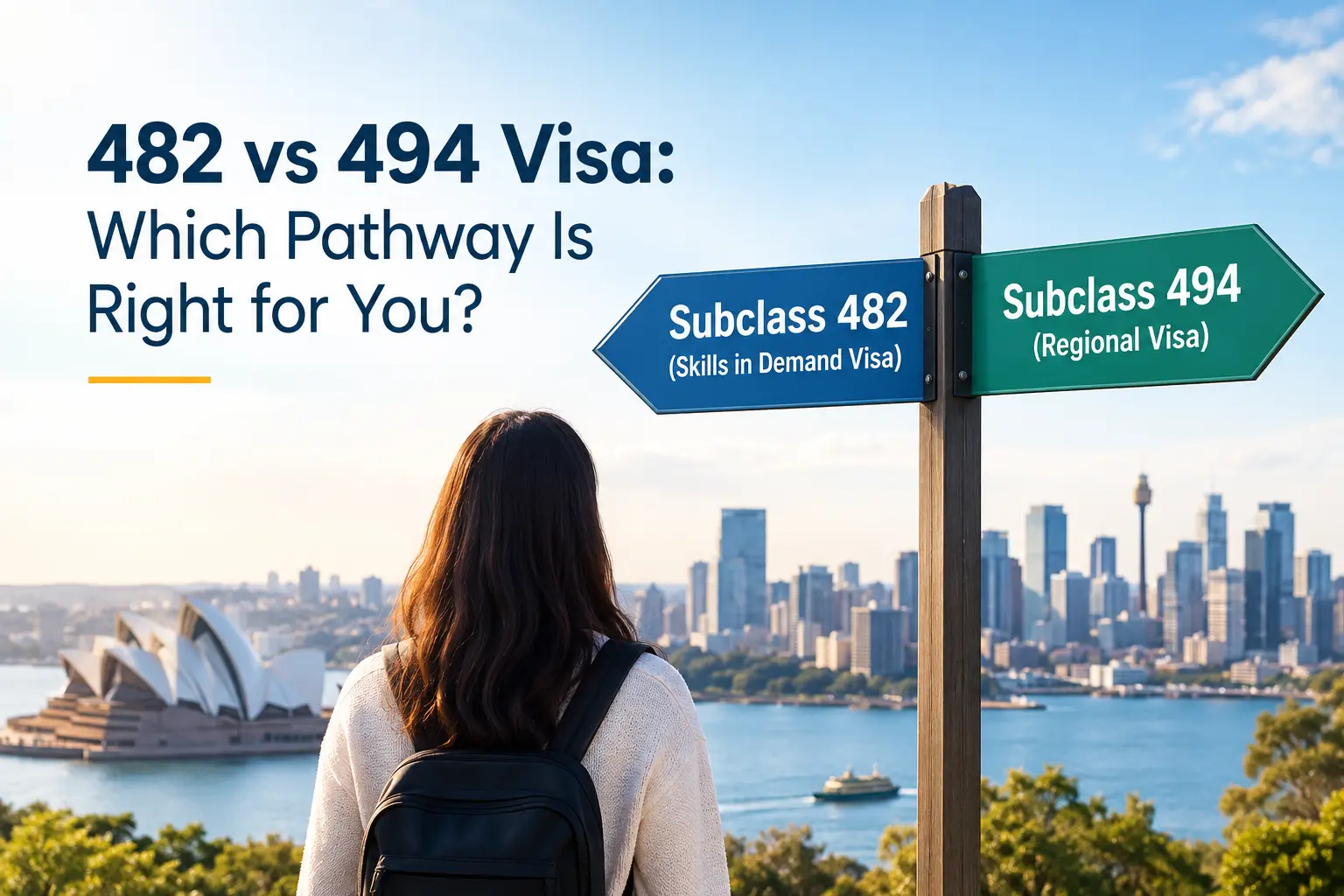
For skilled workers looking to work in Australia through employer sponsorship, choosing the right visa pathway can be confusing. Two options that often come up are the Skills in Demand visa (subclass 482) and the Skilled Employer Sponsored Regional (Provisional) visa (subclass 494).
Both visas involve employer sponsorship and allow skilled workers to work in Australia. However, they are designed for different circumstances, particularly when it comes to where you will work and your longer-term plans.
So, when comparing 482 vs 494 visa options, the right choice depends on your occupation, employer, location, experience and future plans.
What Is the Subclass 482 Visa?
The Skills in Demand visa (subclass 482) allows an Australian employer to sponsor a skilled worker to fill a nominated position. Depending on the relevant stream and circumstances, the visa can be granted for between 1 and 4 years.
The current 482 program includes the Core Skills stream, Specialist Skills stream and Labour Agreement stream.
A key feature of the 482 is that the visa holder generally works for the sponsoring employer or an associated entity and in the nominated occupation, subject to the applicable visa conditions.
For skilled workers who have an employer offering a suitable position outside a regional-only arrangement, the 482 may be a relevant pathway to consider.
What Is the Subclass 494 Visa?
The Skilled Employer Sponsored Regional (Provisional) visa (subclass 494) is designed for skilled workers who are sponsored by an employer in a designated regional area of Australia.
The visa is valid for up to 5 years. One of its main differences from the 482 is the regional requirement. The nominated position must be located in a designated regional area, and the visa holder is expected to live and work within the applicable regional framework.
The 494 can also provide a pathway towards permanent residence through the Permanent Residence (Skilled Regional) visa (subclass 191) if the relevant requirements are met.
Subclass 482 vs 494: Key Differences
Although both visas are employer-sponsored, there are several important differences to consider.
1. Location of the Job
Location is one of the biggest differences.
The subclass 494 is specifically designed for employment in a designated regional area. If you are considering a position in regional Australia and are comfortable meeting the regional requirements, this visa may be relevant.
The subclass 482 does not have the same regional requirement. This can give eligible applicants access to sponsored positions in a broader range of locations.
2. Visa Duration
The subclass 482 can generally be granted for 1 to 4 years, depending on the relevant stream and circumstances.
The subclass 494 is a 5-year provisional visa.
The length of the visa, however, should not be the only factor you consider. Your occupation, employer, location and potential permanent residence options are also important.
3. Permanent Residence Pathway
Both visas can form part of a longer-term migration plan, but the pathways are not identical.
Eligible 482 holders may have access to permanent residence pathways, including the Employer Nomination Scheme (subclass 186), depending on the applicable requirements and circumstances.
For subclass 494 holders, the regional permanent residence pathway includes subclass 191. The Department states that skilled regional provisional visa holders must meet requirements relating to living and working in regional Australia before applying for permanent residence.
This makes it important to consider your long-term plans before choosing between the two.
4. Occupation Requirements
Your occupation also matters.
The subclass 482 has occupation requirements that depend on the stream you are applying under. The 494 has its own occupation framework, and regional skilled migration can provide access to a broader range of occupations than some metropolitan pathways. The Department currently lists 650 eligible occupations for subclass 494.
Having the right job title alone is not enough. Your actual duties, qualifications, work experience and other visa requirements need to be considered.
482 or 494: Which One Should You Consider?
There is no single visa that is suitable for every skilled worker.
A subclass 482 may be worth considering if you have an eligible employer-sponsored position and do not want your employment pathway to be restricted to a designated regional area.
A subclass 494 may be relevant if you have an eligible regional employer and are prepared to live and work in regional Australia as required.
Your future plans matter too. Someone who already has a suitable regional job offer may approach the decision differently from someone whose employment opportunity is in a major city.
Things to Check Before Choosing
Before deciding between subclass 482 vs 494, consider:
● Is your occupation eligible for the visa pathway?
● Does your employer meet the sponsorship requirements?
● Where is the nominated position located?
● Do you meet the relevant work experience requirements?
● Is a skills assessment required in your circumstances?
● What are the applicable salary requirements?
● Which permanent residence pathway may be available later?
● Are you prepared to meet any regional residence and work requirements?
● These details can make a significant difference to your application.
Final Thoughts
The choice between a 482 and 494 visa should not be based simply on which visa has a longer validity period or sounds easier.
The better approach is to look at the complete picture: your occupation, employer, proposed position, location, experience and long-term plans in Australia.
The subclass 482 and subclass 494 are both employer-sponsored pathways, but they serve different purposes. Understanding those differences before starting the application can help you avoid choosing a pathway that does not fit your circumstances.
If you are unsure which employer-sponsored visa pathway may apply to you, professional migration advice can help you assess your circumstances and understand the relevant requirements.
Visit Pathway Education & Visa Services to understand your requirements and plan your pathway to Australia.
FAQs
1. What is the main difference between the 482 and 494 visas?
The 482 visa is a temporary employer-sponsored visa, while the 494 is a five-year provisional visa for designated regional employment.
2. Can a 482 visa lead to permanent residency in Australia?
Yes, eligible 482 visa holders may have pathways to permanent residency, including subclass 186, depending on their circumstances and requirements.
3. Can a 494 visa lead to permanent residency?
Yes, eligible 494 holders may progress to subclass 191 permanent residence after meeting the required regional residence and other eligibility conditions.
4. Do I need to work in regional Australia on a 494 visa?
Yes. The subclass 494 is specifically designed for employment in designated regional areas, and applicable regional conditions must be met.
5. Should I choose a 482 or 494 visa?
The suitable pathway depends on your occupation, employer, job location, eligibility, experience and long-term plans in Australia.